Faculty Interview — Dr. Lenore Wright

Dr. Lenore Wright is associate professor in the Baylor Interdisciplinary Core and director of the Academy for Teaching and Learning at Baylor. Dr. Wright’s academic background is in philosophy. She teaches in both the BIC and the philosophy department. We hope you enjoy this interview with Dr. Wright! (Read more faculty interviews)

lenore_wrightHow long have you been teaching in the BIC? What do you find most rewarding about working with BIC students?

I began teaching BIC courses in 1999, my first year at Baylor. My first BIC course was Examined Life; the second was World Cultures II. Thereafter, I taught World Cultures III, World Cultures I, and the BIC Capstone (co-taught with the incomparable Tom Hanks). Now that I have a course reduction for administrative work (I direct the Academy for Teaching and Learning), I teach only one BIC Course: World Cultures III. I am honored to serve Baylor in an administrative capacity, and I believe deeply in the ATL’s mission to support the development of faculty as teachers, but I do miss BIC students. I am happiest when I’m in the classroom, and I feel renewed by my time with BIC sophomores each fall.

What’s not rewarding about working with BIC students? Their willingness to read widely and think deeply about matters that matter is inspiring. Their ability to make connections among a vast array of ideas and texts is impressive. Their care of self and concern for others is humbling. BIC teaching is rewarding on many levels. What is perhaps most rewarding about working with BIC students is their commitment to the community of learning that BIC fosters: intellectually, spiritually, emotionally, and psychosocially. When they leave Baylor they want to make a life, not just a living. They want to improve themselves and improve the world. I am always struck by their deep desires to make a difference in the lives of others. I admire that. They are young colleagues. And I’m gratified by the professional and personal associations I have continued to have with many former students. Sic ‘em, BIC!

Tell us about your work with the Academy for Teaching and Learning at Baylor.

The mission of the Academy for Teaching and Learning (ATL) is to “support and inspire a flourishing community of learning.” What that means concretely is that I facilitate collaboration between faculty, between faculty and students, and between the faculty and administration on teaching-related endeavors. My charge is to provide programs and resources that develop faculty as teachers. Baylor has many excellent instructors—and many of them teach in BIC! I seek to recognize and honor effective teachers, encourage faculty to experiment with new approaches to teaching, and mentor new instructors as they begin to form themselves as teachers. It’s exciting to engage in dialogue with instructors at different stages of their teaching careers. I enjoy finding ways to meet their specific needs for support and inspiration. I can’t do this alone. Many faculty colleagues join me in my work, which is guided by the ATL Advisory Council (Dr. Schultz and Dr. Hanks are members). I am honored to have colleagues who lead programs, such as Faculty Interest Groups (FIG) or Seminars for Excellence in Teaching (SET). Together we strive to continue the historic tradition of teaching excellence on Baylor’s campus.  Continue reading

Posted in Faculty Interview | Comments Off on Faculty Interview — Dr. Lenore Wright

Alumni Interview — Becky Oberg (’01)

With each year that passes there are more and more BIC graduates doing great work all over the world. At least once each year we hope to publish brief “Alumni Updates” where our alumni can tell us some about their post-BIC lives. In addition to these annual updates, we are posting interviews with some of our alumni. This month we are excited to post an interview with Becky Oberg (’01). We hope you enjoy, and if you are interested in being interviewed for a future blog post, email us at BIC@baylor.edu.

Becky and BikeTell us some about your journey since graduating from Baylor. What are you currently doing for your work/career?

I graduated from Baylor in 2001. During my time there, I majored in journalism and minored in religion, with the hopes of becoming a religion reporter at a daily newspaper. After graduation, I took a job at a small newspaper in Crawfordsville, Indiana, but they got hit with an age discrimination lawsuit a few weeks after they hired me, so I was let go to pay for said lawsuit. After a brief stint in the Army (I was medically discharged during Basic after becoming severely ill with post-traumatic stress disorder and ruled disabled), I started freelancing for an alternative weekly newspaper in Indianapolis. In 2003, I won first prize for features in the Society of Professional Journalists Indiana Chapter Mark of Excellence Awards. I was also nominated for the Indiana Courage in Journalism Award for exposing corruption in military recruiting. In 2004, I landed a book deal with Chamberlain Brothers, a Penguin imprint. The book, “Freedom Underground: Protesting the Iraq War in America”, is about an underground network dedicated to helping suicidal military members desert and go to Canada. In 2009, I won a Web Health Award for my work with HealthyPlace.com, the nation’s largest mental health consumer website. In 2009, I had a poem printed in the Journal of the American Medical Association. I live in Indianapolis and run my own freelance writing business, which is basically a fancy way of saying I’m an independent contractor.

Tell us about your upcoming trip to Kenya.

Despite my PTSD, I’m active in volunteering and I often write about the efforts of volunteers (my story “Biloxi Blues” is an example).  In keeping with this love, I’m planning to go to Kenya in June. I will provide physical support to IMANI Workshops, which helps people with HIV/AIDS get jobs, and the Umoja Project, which helps children who’ve lost one or both parents to the virus–that’s about 20 percent in the area I’ll be in. I’ve queried several magazines to see if they’re interested in articles that might develop.

I will leave Indianapolis on June 13th and arrive in Nairobi on June 14th. On June 15th, I’ll travel by plane to Eldoret, which is 163 miles to the west. I’ll stay in Kenya for two weeks, leaving Nairobi on the 27th and returning to Indy on the 28th. Once in Eldoret, home of Moi University, I will work with IMANI Workshops. IMANI is an offshoot of the Indiana University-Moi University’s Academic Model for the Providing Access to Healthcare (AMPATH), which serves 100,000 HIV+ Kenyans. HIV+ adults in Kenya often face discrimination, and are unable to find jobs or secure loans. IMANI teaches them how to make and sell handcrafted goods, which are then sold at fair trade prices in the United States.  Continue reading

Posted in Alumni, Alumni Interviews | Comments Off on Alumni Interview — Becky Oberg (’01)

Being a Peer Instructor – Kirsten Koschnick

kirstenkoschnickKirsten Koschnick is a second-year BIC student majoring in political science. She is currently finishing her first year as a Peer Instructor in BIC, and in this post she shares some about her experience.

Starting classes your freshman year of college can be scary. There are most likely going to be a few times during your first semester when you feel completely overwhelmed. That’s how I felt going into it, at least, as I think back to my first World Cultures small group. A bunch of nervous, awkward freshmen too scared to make small talk with each other, let alone to analyze and synthesize our assigned readings in front of each other and a really smart professor. But as class gets started, I notice there’s one girl in the room that definitely isn’t old enough to be a professor, but looks far too calm and collected to be one of my fellow freshmen. She introduces herself as our Peer Instructor. So, freshman-me at this point is thinking, “wait, she’s a seasoned BIC student who has taken this class before, and now she’s here to help me? Thank goodness. This means I have someone to help my poor, clueless self.” And just as I thought, this PI—a Ms. Brennan Saddler—ended up being one of the most helpful resources I was given in my freshman year. She would answer my questions without making me feel like the completely lost freshman that I oftentimes felt like, she held study sessions before our tests, and even brought us baked goods occasionally.

Once I finished World Cultures, with much help from Brennan along the way, I admit I was actually pretty bummed. I kept thinking, “what if there was something I missed?!” My grade in the class said that I had learned everything pretty well and fulfilled all the requirements of the course, but I couldn’t help but feel that maybe there were some things I hadn’t comprehended fully or retained as well as I could have. It was almost like I wished I could take the course again, to solidify all my knowledge and be able to re-grasp everything that I found so fascinating in my first round of World Cultures. But then in the Spring, in the midst of being captivated with all the new texts and ideas yet again, but this time in World Cultures 2, an email from Mr. Moore made me realize that the fulfillment of this longing was actually attainable. I could become a Peer Instructor myself! Not only could I again study all the material, but I could share my acquired understandings and insights with new freshmen and help them learn it, too. Thinking back to the profound impact my PI, Brennan, had on my first semester in World Cultures, I immediately knew this was something I really, really wanted to do.

As it turns out, the privilege of being a PI holds even greater benefits than you might realize. First of all, I get to have a second, more perceptive look at everything about World Cultures I and II that captivated me my freshman year. It’s no secret that there’s a huge amount of ideas and information given to you in World Cultures, and no matter how well you do in the class, there’s probably still quite a few valuable things you missed.  Getting to look at all the material with a new, more enlightened perspective lets you grasp the significance of those texts in shaping cultures, be amazed by the profound insight shared by incredible faculty members in lectures and small groups, and appreciate the new batch of freshmen’s understandings of the texts and how they interact with material.  Continue reading

Posted in Current Students, Peer Instructors, World Cultures | Comments Off on Being a Peer Instructor – Kirsten Koschnick

QuickBIC — Thank You, Dr. Walden!

waldenQuickBIC is the BIC student blog, updated with a variety of posts each week. Ada Zhang recently posted a tribute to Dr. Sarah Walden, one of the BIC professors who has made a difference in her life. Ada writes:

“Great teachers aren’t hard to come by at Baylor. I could write an ode to any one of them. But I write about Dr. Walden today because she’s the one responsible for getting the wheels aturnin’ (or however that old adage goes). Looking back, she did tell me I had potential to be a good writer, but that’s not really what made me switch from Business to Professional Writing. It’s more that she showed me, in that 8 a.m. freshman rhetoric class, how through words I have the ability to create, to destroy, and to change the way things are—for better and for worse.

“Dr. Walden encouraged those shy freshmen to wield the power of rhetoric — because, she told us, our ideas matter, because words are free and we are free to use them.

“And look at me now! Going on and on and on about my ideas 24/7. It’s like a disease, really. I can’t help it.” [read the full post at the QuickBIC blog]

Posted in Current Students, Faculty, QuickBIC | Comments Off on QuickBIC — Thank You, Dr. Walden!

Faculty Interview — Dr. Jason Whitlark — Part 2

Jason Whitlark is Associate Professor and Faculty Assistant Director in BIC, where he primarily teaches World Cultures I and Biblical Heritage. Dr. Whitlark holds a Ph.D. in New Testament from the Religion Department at Baylor, and he has a new book that was published in 2014–Resisting Emprire: Rethinking the Purpose of the Letter to the Hebrews. We hope you enjoy learning more about Dr. Whitlark and his research. This is Part 2 of a two part interview (read Part 1).

Whitlark photoWhere do you see your research going in the future? Are you working on any new projects?

My research is still focused on interpreting the Letter to the Hebrews. My main project presently is to publish a book on the rhetorical structure of this letter. I have been working on this project for a few years now with a friend from my graduate school days. We think we have solved the puzzle to the structure and genre of this letter by studying the instructions of the rhetorical theorists. Thus, I have been immersed in ancient rhetorical handbooks. We are excited about what we have found. What remains is to pull our complete argument together for the book and find a publisher. Hebrews continues to be a fascinating text that should continue to occupy my thoughts over the next few years.

Does Baylor have a shot at making the College Football Playoff next season?

So Baylor has shown that it is a power with which to contend in the Big 12, which puzzlingly still only has 10 teams. I think, however, that Baylor has both a Big 12 and scheduling problem. Because Baylor is not a name-brand team any weakness in its schedule gets amplified. Also by not having a championship game, the Big 12 has taken a hit from the playoff committee. With that said, I think if Baylor goes undefeated and puts the hammer down on traditional powers and TCU, then Baylor will be in the playoff. Sic’em Bears!

Is there anything interesting happening with you and your family?

If you come to our house these days you will find that you have entered the world of Middle Earth with elves, hobbits, dwarfs, orcs, even Asok the Defiler. Somewhere in the office lies Mount Doom where we must destroy the ring of power (presently my wedding ring). This all happened quite suddenly. Over the Christmas break my daughter watched The Desolation of Smaug. I had been subtly trying to get her interested in it anyway. The Five Armies was about to come out and I was hoping she would go with me to see it. Well it all worked. The second Hobbit movie captured her imagination so much so that she watched the first one and then went to see the release of the third one. We then watched through the movies all once more when she realized that the story continued from the third Hobbit movie. Well then Christmas turned out to be a Lord of the Rings marathon which then resulted in us subsequently purchasing electronic copies for VUDU so she could watch the movies anywhere. It has been a fun journey to say the least. We talk about sin now as “dragon sickness.” We have a budding egalitarian. Women warriors are awesome. Tauriel is definitely the favorite. Any Gimli quote is always comic relief in the household. We are now trying to read The Hobbit and are hoping that they will make the pre-prequel on the origins of Middle Earth and the races that inhabited it.

Posted in Faculty, Faculty Interview, Publications, World Cultures | Comments Off on Faculty Interview — Dr. Jason Whitlark — Part 2

Faculty Interview — Dr. Jason Whitlark (Part 1)

Jason Whitlark is Associate Professor and Faculty Assistant Director in BIC, where he primarily teaches World Cultures I and Biblical Heritage. Dr. Whitlark holds a Ph.D. in New Testament from the Religion Department at Baylor, and he has a new book that was published in 2014–Resisting Emprire: Rethinking the Purpose of the Letter to the Hebrews. We hope you enjoy learning more about Dr. Whitlark and his research. This is Part 1 of a two part interview. Part 2 will be published later this week.

Whitlark photoHow long have you been teaching in the BIC? What do you find most rewarding about working with BIC students?

I started teaching in the BIC in the Fall 2007. To be honest, I am not sure what I was getting into, but I found the experience in the BIC to be transformative not only for the students but myself as well. Probably the most rewarding aspect about working with BIC students is sharing in their journeys while they are here at Baylor. I get to see BICers enter their college life full of hopes, dreams, and some anxieties, and then I get to see them think deeply about their lives and their vocational pursuits. Their questions, reflections, and learning always cause me to think deeply about my own life and vocation here at Baylor. I did not begin the BIC program (though I wish I could have that glory), but I believe in it because of how it has changed me and not just the students.

Tell us about your new book that recently came out.

My recent book is entitled, Resisting Empire: Rethinking the Purpose of the Letter to the Hebrews published in the Library of New Testament Studies with T&T Clark. In scholarship on Hebrews, there are some, like me, who see the Letter to the Hebrews written to a Christian congregation of predominantly Gentiles living in Rome in the latter half of the first-century (likely after the destruction of the Jerusalem temple by Rome in 70 A.D.). It is clear from the letter that many in the community suffered and were suffering for their confession of Jesus Christ. They were imprisoned, shamed, had their property confiscated, and possibly exiled or martyred. That suffering was tempting some to re-identify with imperial Rome in order to avoid further suffering. The book then explores the ways in which Hebrews, through the use of covert allusion, pushes against the pressures those in the community were facing from their imperial context. For example, the author concludes his correspondence with the statement: “here we do not have city that remains but look for one that comes.” While the author speaks in generic terms about two cities, it seems to me that the audience of Hebrews would have heard the author take a jab at Rome’s boast to be the “eternal city”—an epithet still used today for Rome but now more for tourism. Instead the audience is to continue to identify with Jesus, including the shame he suffered on earth, and to hope for his coming eternal city—the heavenly Jerusalem. Continue reading

Posted in Faculty Interview, Publications, World Cultures | Comments Off on Faculty Interview — Dr. Jason Whitlark (Part 1)

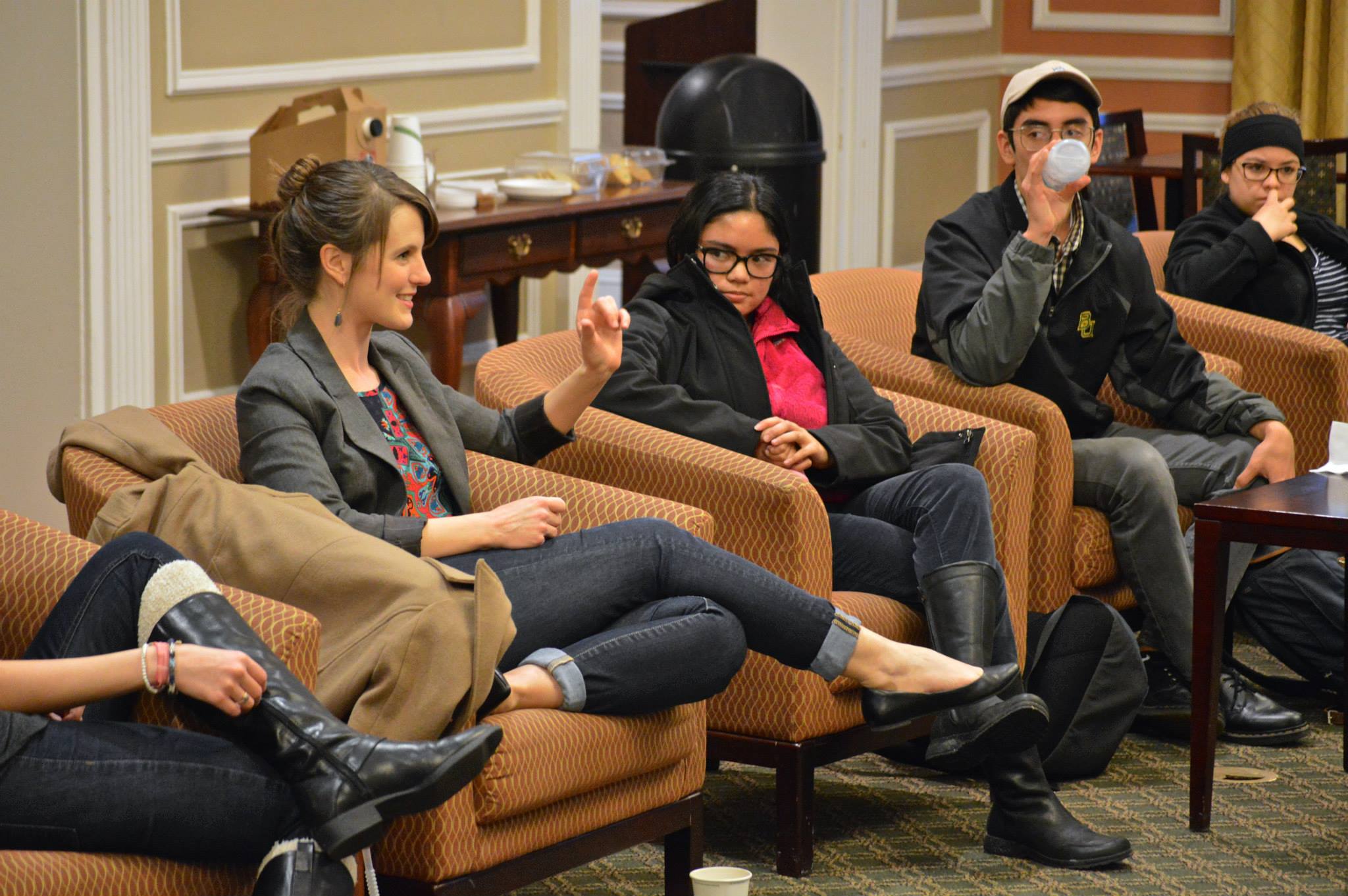
“A Lesson on Comedy” — Dr. Perry in the Lariat

Sam Perry

From the Baylor Lariat (read the full article):

Dr. Samuel Perry, assistant professor of the Baylor Interdisciplinary Core and Honors College, and Waco community members gathered at 5:30 p.m. at St. Alban’s Episcopal Church to discuss the effects of laughing at culturally and racially sensitive jokes.

The Community Race Relations Coalition’s crowd of nearly 50 participants welcomed Perry to its quarterly meeting.

“Comedy provides a way to talk about things that remain difficult to understand,” Perry said during his discussion on navigating how to react to hearing culturally and racially sensitive jokes.

Perry welcomed comments and questions from the diverse audience, which included questions about how to educate someone after they have made a joke with an intention to harm others.

The Southeast Texas native stressed the importance of knowing the intention and context of jokes as a way to be mindful of what someone is truly laughing at.

While Perry’s lecture was a lesson on comedy, it was not a dictation on what one is allowed to laugh at. This was all in an attempt to avoid limiting a person’s free speech. [read the rest at the Lariat website]

Photo credit: Kevin Freeman, Lariat photographer

Posted in Faculty, Lariat | Comments Off on “A Lesson on Comedy” — Dr. Perry in the Lariat

Houston Chronicle Op-Ed — Mark Long

chronicle image

[The following article was written by Dr. Mark Long and appeared in the January 18, 2015 print edition of the Houston Chronicle]

“Looking for a Boy Named Rhonda”

To grow up in the South in the 1950s was to enjoy all the comforts of segregation, at least if you were white. And so I did. In my suburban neighborhood in Houston (West University), mine was an almost idyllic early childhood of segregated security, segregated good schools, an all-white Little League baseball team. My acquaintance with Black Americans was rather limited, and those I did meet showed me a kind of deference as a white that now causes me to wince as I recall it. Moreover, to travel in the South was to see firsthand the Jim Crow laws that still prevailed: motels that were marked “whites only,” the crudest sort of toilet facilities marked “coloreds only,” and the side by side water fountains, one with a deluxe water cooler and the other little more than a simple faucet. I need not indicate which was for whom.

Apart from our black maid, a kind of surrogate mother (both “ship and safe harbor,” as writer Toni Morrison puts it), my only other contact with people of color was limited to our neighborhood yardman, someone we knew simply as “Wallace,” and with his sons. Wallace–first name? Last name? I never learned–came weekly from cross-town to do several of the lawns in our area. All his boys save the youngest, who appeared to be about my age, helped with the chores. For at least two summers I saw Wallace’s youngest from a distance as we would stand and stare at each other briefly. Then came the day—I would have been about nine—when we bridged the distance. Continue reading

Posted in Faculty | Comments Off on Houston Chronicle Op-Ed — Mark Long

Dr. Long in Saudi Arabia

mark long

A few words from Dr. Mark Long who just returned from a trip to Saudi Arabia. Dr. Long writes:

“This photo is from New Year’s Day on the Persian Gulf. I had traveled to Saudi Arabia with a group of students and faculty from different universities across the States. This picture was taken outside Jubail, where most of the Kingdom’s oil resources are located. During the two week trip we met with representatives of government, industry, the media, and other universities.”

Update 1/30/2015: Dr. Long has written an extended reflection on his recent travels in Saudi Arabia published at the Waco Tribune-Herald. It’s well worth the read–link. Here is a brief excerpt from the article:

“The sun slowly emerged from the mauve haze over the water. Black shore birds dined along the coast, as seagulls performed their acrobatics above them. Several couples walked along the corniche in al-Khobar in the cool air, their amble just the right pace for quiet conversation and the chance to watch the spreading light over the ripples. Some, just as I was doing, ran along the curving walk by water’s edge.

“Others had gathered to do calisthenics. But most of us paused for the moment when the sun emerged and began to turn a deep red. And then the young couple. He watched as she adjusted her hijab, face uncovered. Turning away from the magnificent sunrise, she held her phone at arm’s length to take a selfie. I saw that in the cool morning, half a world away from Waco, as I ran along the Persian Gulf (or “Arabian Gulf,” as my Saudi hosts would remind me) on the first day of 2015.” (read the full article)

Posted in Faculty, World Cultures | Comments Off on Dr. Long in Saudi Arabia

Faculty Research — Davide Zori

zoriDavide Zori is one of the newest additions to the BIC faculty, having just completed his first semester at Baylor. Dr. Zori’s research concentrates on the Viking expansion into the North Atlantic. He conducts archaeological fieldwork in Iceland addressing the interaction of the Norse settlers with new environments, the construction of a migrant society, and the subsequent evolution of endemic political systems. Baylor Media Communications recently highlighted Dr. Zori’s research in an article titled “Beef, Beer, and Politics.” You can read an excerpt below or go to the Media Communications website for the full story, written by Terry Goodrich.

———————————-

Vikings are stereotyped as raiders and traders, but those who settled in Iceland centuries ago spent more time producing and consuming booze and beef — in part to achieve political ambitions in an environment very different from their Scandinavian homeland, says a Baylor University archaeologist.

The seafaring warriors wanted to sustain the “big man” society of Scandinavia — a political economy in which chieftains hosted huge feasts of beer and beef served in great halls, says Davide Zori, Ph.D., a Denmark native and archeological field director in Iceland, who conducted National Science Foundation-funded research in archeology and medieval Viking literature.

But instead, what Zori and his team discovered is what happened when the Vikings spent too long living too high on the hog — or, in this case, the bovine.

“It was somewhat like the barbecue here. You wanted a big steak on the grill,” said Zori, assistant professor in the Baylor Interdisciplinary Core, who co-edited the book Viking Archaeology in Iceland: Mosfell Archaelogical Project with Jesse Byock, Ph.D., professor of Old Norse and medieval Scandinavian studies at the University of California, Los Angeles.

“It made it really showy — if you could keep it up.” [read the full article]

Posted in Faculty, World Cultures | Comments Off on Faculty Research — Davide Zori