For the next five weeks, we’re putting up teasers about the fascinating Baylor history, 1921-1930, that Higher Education and Student Affairs students analyzed and shared on the Foundations and History of Higher Education class blog. This week we’re looking atCurriculum at Baylor, with papers examining the 1920s evolution controversy, the founding of the business school, and the developing Spanish department. Did you know that…
The Baylor University business school began in 1923 and became known as the Hankamer School of Business in 1959 when Earl C. Hankamer gave most of the money needed for the school to have its own building. This Windy Drum photo was taken shortly after construction was completed. Baylor–Buildings–Hankamer School of Business.
President Samuel Palmer Brooks was concerned that the student body, incensed by J. Frank Norris’ accusations against the university on the teaching of evolution might be incited to mob action by Norris himself as a publicity stunt in his favor. Read more…
One of the motivations for beginning the business school in 1923 was that Baylor’s male enrollment was dropping, as men were going to UT (where they could pursue business studies) instead of Baylor. Discover more…
Spanish faculty members in the 1920s sometimes were called on to teach other subjects, such as German and chemistry. (Fortunately, the professors in question did have background in those disciplines!) Learn more…
We hope you’ll explore these blog posts and enjoy the benefits of the HESA students’ research and scholarship. If you’re inspired to dig deeper, most of their sources can be found in the University Archives within The Texas Collection and in our digitized materials available online in the Baylor University Libraries Digital Collections.
Background on this project: Students in the Higher Education and Student Affairs (HESA) masters program have taken on the challenge of creating original scholarship that adds to what is known about Baylor’s history. As part of Dr. Nathan Alleman’s Foundations and History of Higher Education course, students were grouped under the five class themes: curriculum, finance, students/student groups, access, and religion. In collaboration with Texas Collection archivists and librarians, students mined bulletins, newspapers, correspondence, and other primary resources as they researched their topics. Final papers have been posted on blogs.baylor.edu/hesabaylorhistoryproject and grouped by their particular sub-topic so that patrons, researchers, and other interested persons could benefit from these students’ work. This is thesecond installmentof an annual accumulating project–see last year’s teasers here. Please visit again for future installments!
Texas has changed quite a bit over the years, as is readily seen in our vast photograph collection. To help bring some of those changes to life, we’ve created a “Texas over Time” series of GIFs that will illustrate the construction and renovations of buildings, changing aerial views, and more. Our collections are especially strong on Waco and Baylor images, but look for some views beyond the Heart of Texas, too.
Designed by architect William Lamour and completed in 1887, Old Main was the first new building at the new site for Baylor University after it moved from Independence. The original building had 17 classrooms and 24 offices.
Baylor students used to conspire to get on the roof of Old Main to put their class’ graduating year in large numbers on the roof and spires. However, erasing previous class’ efforts was not easy! The building’s roof became littered with fading numbers from years past.
The iconic Old Main spires had to be removed due to damage from the 1953 Waco tornado (as seen in the second photo above). They were not added back onto Old Main until a 1970s restoration. Before the decision was made to restore the building, there were considerations of tearing it down.
Photos date to approximately 1949, late 1950s, and 1990s and can be found in our Old Main photo files, which have been digitized and are available online in our ever-growing digital collection of Texas photos. See our Flickr set to get a closer look at the images above and a few photos of the spires being restored to the building.
By Amie Oliver, Coordinator for User and Access Services
Looking for information on a prominent Texas figure or ancestor? The Bio Gaz might be the resource for you! But you don’t have to come to our reading room (although you’re welcome)–you can search online!
“Do you have any information on my grandfather?” Texas Collection (TC) staff is regularly greeted with patrons seeking information on people. Typically we point patrons in the usual direction of census, birth, death, and marriage records. These records can provide the who, what, when, and where. But where do patrons look when they want to find the why or how? There is a resource unique to our collection that may help patrons answer those questions.
The Texas Collection is home to numerous volumes containing biographical sketches of notable Texans and early pioneers. Many of these books do not contain an index, and when a patron needs information on a person, it can be overwhelming for staff and the patron to search through nearly 200 volumes of biographical sketches to find someone.
So, in the early 1980s, TC staff created a Biographical Sketch File. After identifying the volumes to be included in the file, staff created a catalogue card for each person listed in the biographical sketches. Each card included a name, birth and/or death date (if available), the book title, page number where the sketch can be found, and whether a portrait is included. This Biographical Sketch File became a popular finding aid, so in 1985, The Texas Collection published it as the Biographical Gazetteer of Texas. (You might hear our staff call it the “Bio Gaz.”) This six-volume set includes over 67,000 entries.
After using the Biographical Gazetteer of Texas in book form for over 20 years, staff and student employees entered the information into a searchable database in 2007. You can access it on our website—follow the instructions below to get started!
Step 1: Click the “Biographical Gazetteer” link on our website (move the bottom slider until you see it in the list).
Step 2: Click on the “here” to search the database.Step 3: Type a person’s name and click the “Click Here to Find” button. (Do not hit enter after typing a name because the search will not work.) Be aware that many people use initials, so first names aren’t often necessary and may even return incorrect results. There also are many variant name spellings, so patrons should try several options.
Step 4: Results! This list informs the patron about where information may be found. If patrons see an entry that fits their search criteria, they may either come in to view the item or may request a photocopy of the material. To request a photocopy, click on the record number.
Step 5: On the next screen, enter contact information and submit the request. Staff will then contact the researcher with photoduplication fees.
Texas Collection staff often uses the Biographical Gazetteer of Texas and we hope that it is a resource that helps our patrons as much as it helps us. Happy hunting!
“Print Peeks” is a regular feature highlighting select items from our print collection.
The Judge R.E.B. Baylor statue sits on Founders Mall, between Waco Hall and Pat Neff Hall.
If you’ve been to the Baylor campus, chances are good that you have climbed into Judge Baylor’s lap for a photo opportunity. But it took awhile to arrive on that design—the statue was very nearly a standing portrait. (Imagine how different the photos would be!) In honor of R.E.B. Baylor’s birthday this week (likely on May 10), learn how this memorial to Baylor’s namesake came into being.
Preparations for the 1936 Texas Centennial Celebration brought a variety of bright opportunities to the state’s Depression-ridden economy. Towns, counties, and institutions, anticipating a burst of tourism, prepared to attract visitors by capitalizing upon their historical figures and events; and many of the nation’s underemployed artists and craftsmen, aware of the potential commissions which such commemorations could engender, began scouring the state in search of work. To help them find employment, one of the federal government’s New Deal assistance programs appropriated funds in 1935 for disbursement by the Texas Centennial Commission of Control in payment for their work.
Baylor President Pat M. Neff, ever alert to means of channeling outside funding into the university, was quick to recognize the possibilities of this federal largess. No substantial monument had ever been raised on Baylor’s campus to the school’s founder and namesake, Judge Robert E. B. Baylor, and Neff applied for and received a grant of $14,000 for the erection of a memorial to him.
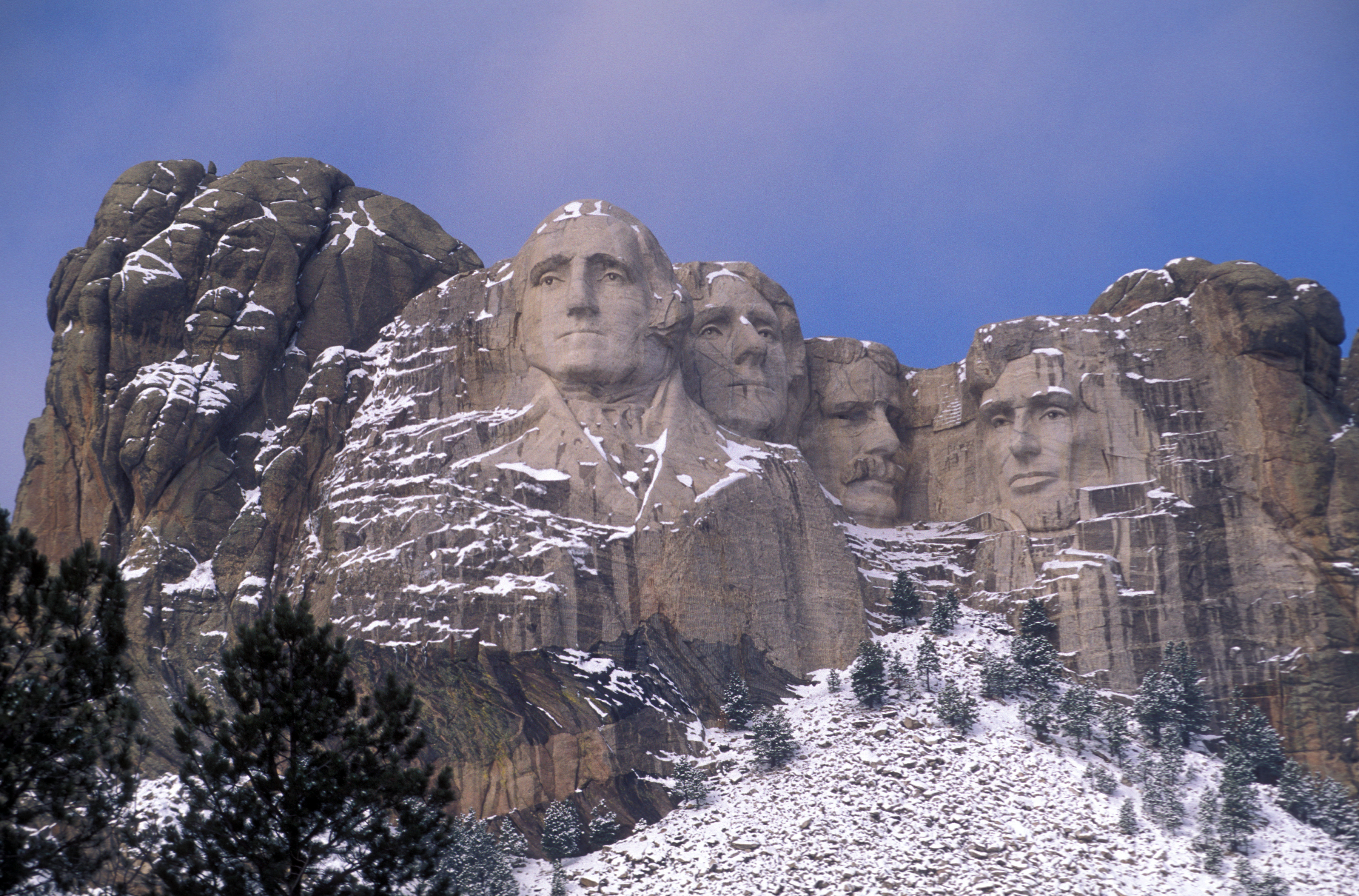
Did you know that the artist of Mount Rushmore, Gutzon Borglum, was considered as the sculptor for the Judge Baylor statue commission? Photo courtesy of TravelSD.
On October 21, 1935, during a chapel service, he named a committee to decide upon the use to which the funds would be put….In addition to reaching agreement about the type of monument which they wanted, they had to select its location, view proposals submitted by sculptors, and recommend to the Commission of Control the artist best able to perform the work…. the committee’s first approval centered upon two proposals made by Gutzon Borglum, sculptor of Mount Rushmore.
The more elaborate of Borglum’s drawings featured a portrait statue of Judge Baylor on a central pedestal, dressed in “a flowing robe of academic suggestion.” Flanking the pedestal at ground level were curved benches, on one of which reclined “the charming figure of a young man, reading,” while on the other sat a young woman “gazing upward as if entranced by the statue.”…The second proposal, favored by committee and sculptor alike, consisted of “a simple statue of Judge Baylor in the dress of the period,” with figures of a young man and woman in high relief on the pedestal’s sides….
Coppini’s clay model for the Judge Baylor statue. Pompeo Coppini papers #1490.
The committee liked Borglum’s work, but he broke off contact with the committee to pursue another commission. In January 1936, they nearly approved a proposal by Chicago sculptor Leonard Crunelle (another portrait statue concept), but committee meetings ceased for about nine months, and then Pompeo Coppini of San Antonio came up.
Coppini’s abilities were a known quantity on Baylor’s campus. One of his first commissions in the state had been the statue of former president Rufus Burleson, erected on Burleson Quadrangle in 1905….
At its meeting of September 21, 1936, the Monument Committee voted to request a proposal from Coppini, and the artist visited the campus shortly afterward. By July 1937, having received a firm commission to undertake the work, he returned to consult with the committee and settle final details….
Judge R.E.B. Baylor Statue, Baylor University, after the unveiling at the Founders Day dedication ceremony in 1939. Pompeo Coppini papers #1490.
Coppini quickly decided that, for best lighting effect, the statue should face to the south, across the street from Waco Hall. Judge Baylor’s pose required more deliberations—a seated figure could cost more, but also would be more distinctive. The committee also discussed adorning the pedestal itself with bas relief figures symbolic of Judge Baylor’s interests in religion, law, and education, but then agreed with the sculptor on a simpler design.
With all essential details decided, Coppini departed to his studio to design, model, cast, and eventually deliver the product of his own and the committee’s labors. The completed statue of Judge Baylor, unveiled during Founders Day observances on February 1, 1939, was an immediate success within the Baylor community.
This compilation of a two-part article by former Texas Collection director Kent Keeth was originally published in The Baylor Line in April and June 1984. Blogging about Texas periodically features “Looking Back at Baylor” selections, with hopes of sharing Keeth’s work with a new audience.
Each month, we post a processing update to notify our readers about the latest collections that have finding aids online and are primed for research. Here’s the scoop for April:
Letter from Dock Martin to Guy B. Harrison describing the W.C. Brann-Baylor incident. (For more on Brann, see the Handbook of Texas online.) Martin’s papers document everything from his own experiences as a Baylor student to his work for the state of Texas and for Baylor as a trustee. D.K. “Dock” Martin papers, box 3, folder 10.
D.K. “Dock” Martin papers, 1916-1968, undated: Materials relating to D.K. Martin, a Texas public official and Baylor University fundraiser and booster. Martin raised money for various historic Baylor buildings, including Rena Marrs McLean Gymnasium, Tidwell Bible Building, Alexander Residence Hall, Morrison Hall, Armstrong Browning Library, and Marrs McLean Science Building.
Denson-Baskin family papers, 1898-1956, undated: Correspondence, legal documents, literary productions, and photographs produced by the extended Denson-Baskin Family in early twentieth century Texas, documenting Central Texas life as well as World Wars I and II.
Specimen letter soliciting donations to finance the S. P. Brooks Memorial Organ. Waco Hall, a gift from the citizens of Waco to Baylor, was dedicated in 1930, but without a pipe organ (and since the building hosted Chapel, one was very much needed). After the death of Baylor president Samuel Palmer Brooks, the Alumni Association began a fundraising campaign to secure funds to purchase and install a pipe organ in Waco Hall in honor of President Brooks. BU Records: S. P. Brooks Memorial Organ Committee #BU/52, box 1, folder 3.
This month, we’re introducing “Print Peeks,” a regular feature examining select items from our print collection. Did you know that The Texas Collection has more than 167,000 books and more than 3,000 active serials titles? And that does not even get into our vertical files and other material types. Our first entry looks at one of our Texas newspapers. Enjoy!
By Sean Todd, Library Assistant
From 1892 to 1901, the Artesia was a popular Waco newspaper with a circulation of over 2,500 at its height. As a society paper, the Artesiafocused its coverage on social events and comings and goings of Wacoans. A typical issue included columns titled “Happenings of the Week—Movements of People You Know,” with items on the Shakespeare Club, the ladies of Waco organizing the parade for “Street Fair Week,” and reports of the local dinner parties with a list of interesting visitors from Houston and San Antonio.
The paper was founded by a prominent member of the Waco Jewish community, Isaac Goldstein, and thus featured more activities of Jewish organizations of the time than did other papers. Goldstein, along with Louey Migel, owned a successful department store in Waco. Not surprisingly, Artesia’s pages were full of advertisements proclaiming the latest fashions and their availability at Goldstein-Migel. Vital to the Artesia’s publication was Kate Friend, who served as editor. Along with her duties at the paper, Friend was an authority on Shakespeare and an advocate for animal rights, even speaking on the subject in Washington, D.C., in 1935.
The 1900 Easter Artesia was one of the few instances that the Artesia featured a color front and back page. Color printing was a much costlier process and reserved for special occasions. Major holidays such as Christmas and Easter were more likely to be celebrated with full color pages because of the positive feelings associated with the event. (Occasionally, Sunday comic pages might get some red ink, and major news headlines would sometimes be printed in red.)
This Easter edition of the Artesia was published on April 15, 1900, and the content is typical of the publication. Notes from recent club meetings and social gatherings fill all four pages. However, the front and back covers are far from standard. The front cover (see above) features a powerful image of an angel, standing with purpose and eyes fixed upward. The mix of soft Easter pastels with a vibrant red and yellow background is striking.
The back cover (to the left) includes festive scenes of children holding flowers and coloring Easter eggs. At the top is an advertisement for the Auditorium as a summer venue for people to come and enjoy the warmer weather. This seems to be a reference to the Auditorium Theater which, according to the 1900 Waco City Directory, was built at the corner of 6th and Columbus and had a seating capacity of 7,000. At the bottom of the page is an advertisement for the self-assured dress maker Miss Poyntz, who proudly claims that “I can not do poor work; I don’t know how.” Both advertisements seem to be well timed as Waco began to anticipate the summer and upcoming social events.
The artwork featured in this edition of the Artesia is not only beautiful but provides the modern reader with a window in which to view holiday traditions that are more than a century old.
Interested in learning more about the Artesia? We believe we have the full run of the paper, which you can come and peruse in our reading room…among many other newspapers, Texas and otherwise!
The fan favorite Ted Lyons, “The Sunday Pitcher,” is given a gift (is it the car?) from the White Sox contingent. Ted Lyons papers #1485, Box 1, folder 5.
It is every young Little League pitcher’s dream: to lead a college baseball team to a conference championship, try out for a major league team, and pitch in the majors in the very same month. But for Baylor star pitcher Ted Lyons, this scenario was not just a dream, but a happy reality. The Theodore “Ted” Amar Lyons papers, held at The Texas Collection, tell the story of Lyons’ mercurial rise to fame as a Hall of Fame pitcher for the Chicago White Sox, the only Baylor baseball player to have such great success at the professional level.
The Baylor Lariat headline when Ted Lyons led his team to a Southwest Conference victory in 1923.
Admitted to Baylor on a baseball scholarship in 1919, Ted Lyons was also the starting center for the Baylor basketball team. After his coach convinced him to try pitching, Lyons’ career took off. His Baylor baseball years culminated in a victory over the Texas Longhorns in 1923, where Lyons pitched a 6-2 game to claim the Southwest Conference Championship. On July 2 of that same year, Lyons signed a contract with the Chicago White Sox and pitched in his first major league game the very same day.
“Three Kings of England wearing derbys shake hands with Teddy Lyons: George V, Edward VIII, then Prince of Wales, and George VI, when he was on tour in England 15 years ago.” (Description from Baylor Century, January 1943.) Ted Lyons papers #1485, Box 1, folder 4.
According to Chicago newspapers, Ted Lyons quickly became the most popular player on the White Sox team. His career would span 21 years, winning 260 games with a not-so-successful team that never finished higher than third in their division. His career included three 20-win seasons, and he led the league in wins twice. Amazingly, Lyons pitched an entire 21-inning game on May 4, 1929. Lyons was so reliable and popular that from 1939-1942 he pitched almost exclusively on Sundays, the day of highest park attendance. Thus Ted Lyons became known in baseball as “The Sunday Pitcher.”
Ted Lyons with the Baylor University Band, undated. Ted Lyons papers #1485, Box 1, folder 4.
In 1942, after a season where he posted an exceptional 2.10 ERA, Lyons left baseball to join the war effort. As a Marine, Lyons served primarily in the South Pacific, notably organizing a baseball camp in the Marshall Islands to spread goodwill with America’s national pastime. After returning to the White Sox in 1946, Lyons pitched one more season before becoming the Sox manager for three years. He was inducted into the National Baseball Hall of Fame in 1955.
Ted Lyons pitching for the Chicago White Sox, where he spent his entire 21 year career. Ted Lyons papers #1485, Box 1, folder 5.
Ted Lyons never married and spent the rest of his life back home in Lake Charles, Louisiana. Even as late as 1981, he was receiving hundreds of autograph requests each year. He died on July 25, 1986. His legacy and career as a Baylor Bear and White Sox pitcher are an indelible part of Baylor’s history. His small collection of papers at The Texas Collection, consisting of letters, clippings, and photos, will preserve his memory and fuel baseball dreams for generations of Little Leaguers to come.
Texas has changed quite a bit over the years, as is readily seen in our vast photograph collection. To help bring some of those changes to life, we’ve created a “Texas over Time” series of gifs that will illustrate the construction and renovations of buildings, changing aerial views, and more. Our collections are especially strong on Waco and Baylor images, but look for some views beyond the Heart of Texas, too.
Brooks Hall, Baylor University
The fifth floor of Brooks Hall was rumored to be haunted by “violin music, a phantom in a top hat and cloak, and inexplicable candlelight moving around.”
The original cost to build Brooks Hall was $365,530 (or roughly $4,690,000) in today’s dollars.
Up until 1987, Brooks Hall had no interior hallways. Each suite opened into a stairwell. This was intended to make the building more fireproof, more efficient with ventilation, and reduce noise. It was redesigned in 1987 for fire safety and practicality.
When it became implausible to renovate and restore Brooks Hall, Baylor decided to construct Brooks Village. Architects took trips to Oxford and Cambridge in search of the new residential community’s architectural inspiration. The architects also used elements from buildings at Harvard and Yale.
Sources
Baylor-Buildings-Brooks Hall. General photo files, The Texas Collection.
Buildings: Brooks Hall. Baylor University Subject File. The Texas Collection.
Gif and factoids prepared by Timothy Brestowski, student library assistant
Here’s a Flickr set that includes the images used to compiled this animation (plus a few more of Baylor students and the campus over time), should you want to examine each photo individually.
Each month, we post a processing update to notify our readers about the latest collections that have finding aids online and are primed for research. Here’s the scoop for March:
Housewarming program for newly reconstructed F. L. Carroll Chapel and Library, 1923 December. Having been destroyed by fire, the building (sans chapel) reopened to the public during the celebration of President Samuel Palmer Brooks’s sixtieth birthday. BU Records: Alumni Rebuilding Campaign #BU/58, box 2, folder 12.
BU Records: Alumni Rebuilding Campaign, 1922-1923: The records of the Alumni Rebuilding Campaign consist of correspondence, financial documents, and administrative records regarding fundraising efforts to rebuild Baylor’s F. L. Carroll Chapel and Library after the building was destroyed by fire in 1922.
Hosea Garrett papers, 1856-1878: The Garrett papers contain correspondence and financial documents primarily produced by Hosea Garrett during 1856-1863. Garrett was a trustee of Baylor University at Independence and a major donor throughout the early years of Baylor.
State of Baylor University report by President George Baines, 1862. The report to the Board of Trustees documents the difficulties of leading the university during the American Civil War, with students and professors leaving all the time and tuition bills not being paid.
In our previous BARD posts, we’ve been exploring how to make the most of our new database in various ways. In our last post in this series, we offer a few more ways to discover Texas Collection resources: tips on browsing larger collections, using BARD’s advanced search, and opening attachments to collections.
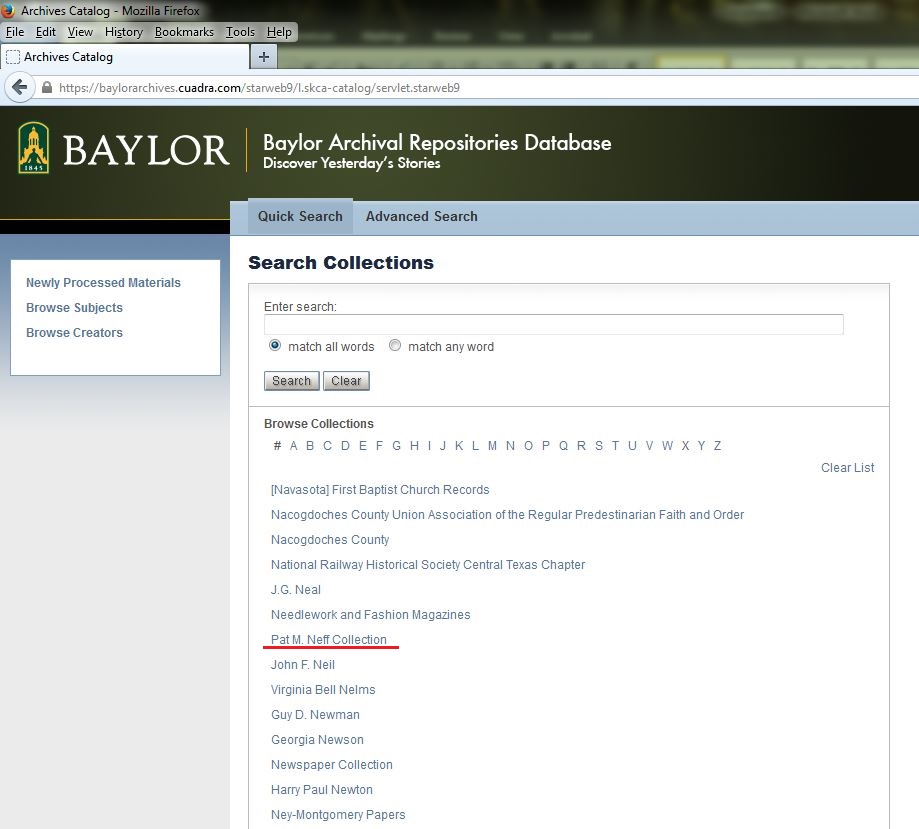
You can enter the BARD system by clicking the link on our home page. We have already learned how to search by keyword, but maybe you already know the title of the collection you want to see and just need to know which boxes to request. For example, you might want to look at Pat Neff’s finding aid. You could enter “Pat Neff” into the search field like we did before, or you could click on the blue “N” for “Neff” under “Browse Collections.” If the collection features a person, then it will be filed under their last name in the system.
As you can see below, clicking these letters can bring up a lot of collections! The Neff collection is in the center of the page. Once you have found the collection you want, click the title to bring up the finding aid.
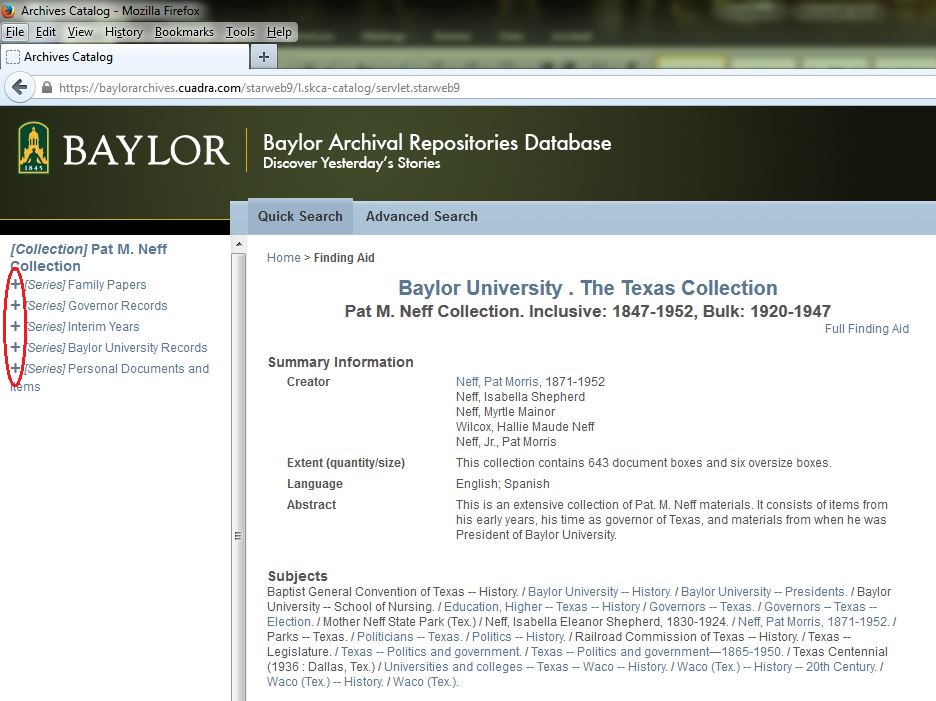
The Neff collection finding aid is different from some others because it is so big. For example, on the left, there are blue + signs to the left of the series titles. In the first blog post in this series, we discovered that by clicking on the series titles, we could bring up just that part of the collection. In the Neff collection, you can click on the blue + symbols to expand your viewing options within the series. By clicking on these new options, you can go to an even more specific part of the collection.
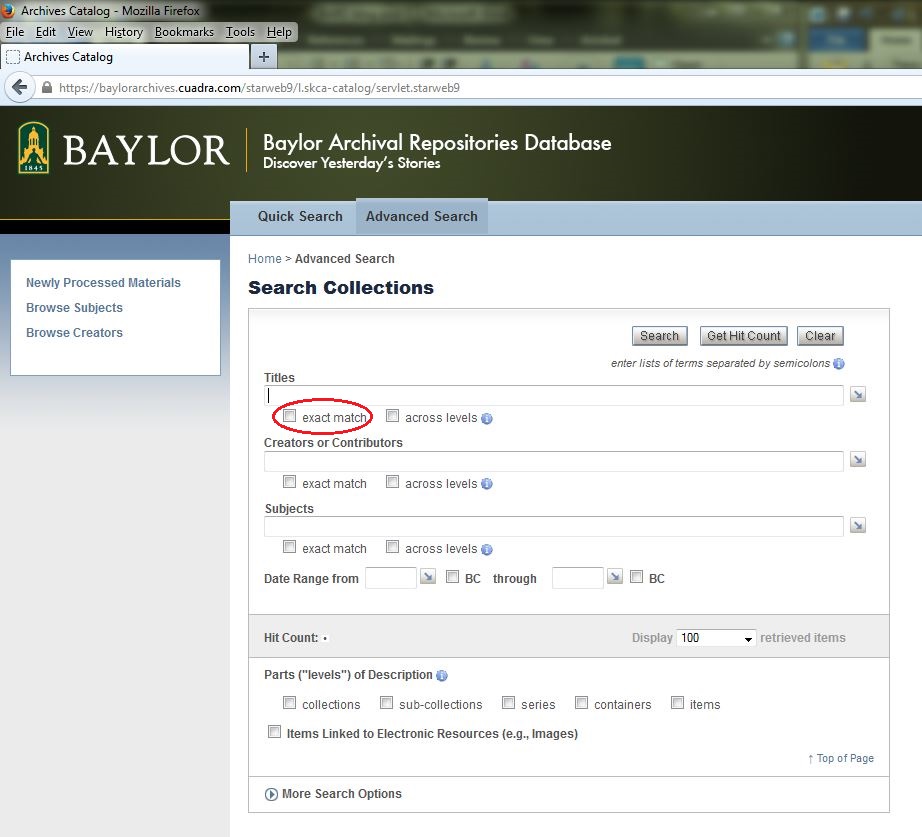
Another way to search for collections is to use the advanced search feature. You can easily access this feature by clicking “Advanced Search” in the blue bar at the top of the page.
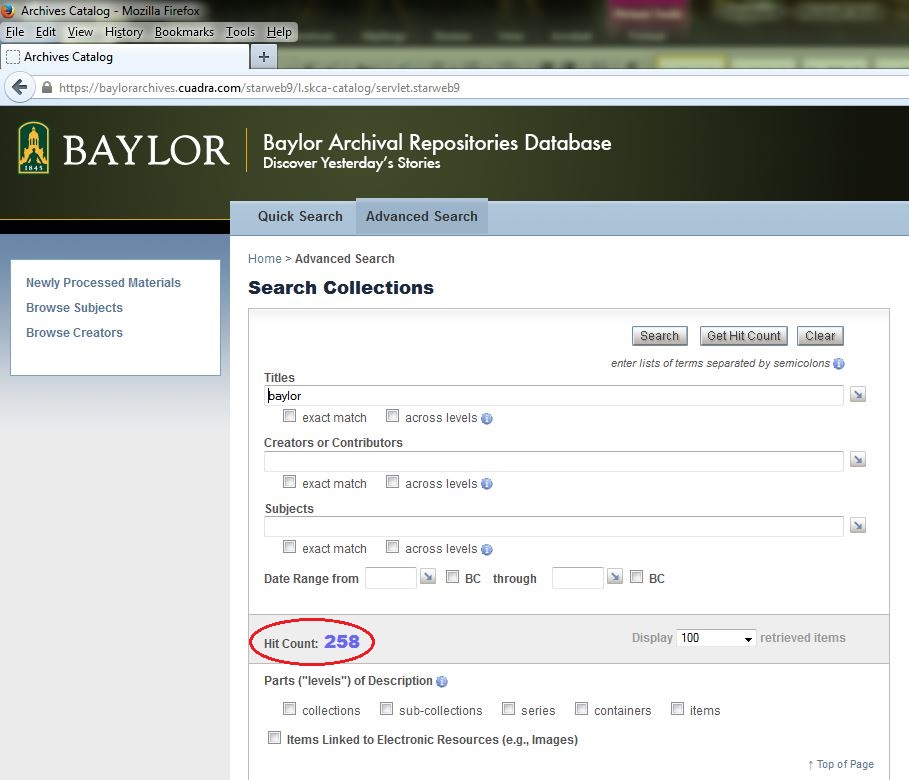
There are several handy things that can help in using this way to search. For titles, creators, and subjects, you can narrow the search by checking “exact match” so that the system is only searching using your exact words.
You can also enter a term to search in the title, creator, or subject box, and then press “Enter” or click “Get Hit Count” in the upper-right corner. The hit count number tells you how many times your term appears across all collections. This can be handy if you are looking for something specific; it can tell you quickly how many potential places you might need to research (or if perhaps you should refine your search terms).
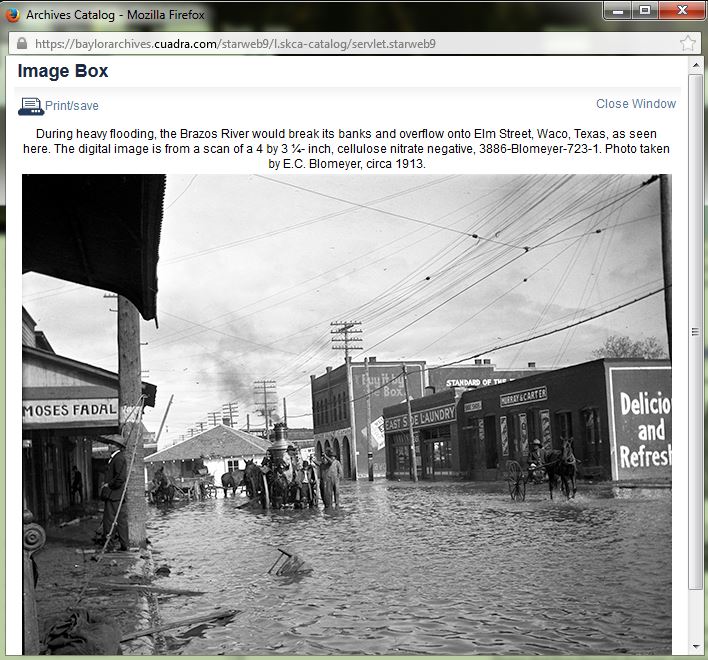
Another helpful tool on Cuadra Star is the ability to view files attached to collections. Some collections may have examples of photographs found in collections, family trees, or other files attached to them. For example, the Edward C. Blomeyer Photographic Collection finding aid in BARD includes some samples of photographic materials in the collection. To get to them, search using the keyword “Blomeyer,” click on the finding aid, and expand out the blue + symbols. You can click on any of the titles next to the + links, but as an example I clicked on “Cameron Park, Rivers, and Bridges” under “Texas” and “Waco.”
Once you get here, you can peruse the thumbnail photographs as they are on the page, or you can expand them by clicking on a photo.
Usually in this view you can see information about the photograph, what we call “metadata”—information giving you context for the item, which may be helpful for your research and citation.
When you are done viewing finding aids in BARD, be sure to close down the system properly. In the main search page, in the upper right corner, click the red “Log Out” to exit from BARD. Leaving the system in this way is very important to ensure the proper functioning of the system.
This concludes our series of how to navigate in BARD. If you have any questions as you are using it, please let us know!