
Kindling the Flame — Anna Watson (’09)

This article is part of our series in which we invite BIC alumni to contribute articles connecting their own work, education, experiences, or interests to their BIC education. Today’s contribution is from Anna Watson (’09), Director of the Meridian Freedom Project in Meridian, Mississippi. We hope you enjoy, and if you are interested in contributing an article, email us at BIC@baylor.edu.

—————–

After graduating from Baylor in 2009, I joined Teach for America and moved to Houston where I spent a summer trying to teach an impossibly confusing summer school course called ‘World Geography’ to a group of high school students at Davis High School. It was so bad I once had a student get up and run out of the classroom for home. (I decided not to chase him.) From there, being an English major, I was placed in the Arkansas Delta with a more suitable assignment teaching AP Literature and 10th – 12th grade English. I taught my required two years and loved my community and my students so much that I taught for two more. However, this work was incredibly hard, and while there were many rewarding moments, knowing how high the stakes were for my kids made it tough to feel true success. As a state-tested teacher, I was constantly torn between approaching my role as an educator in two ways: simply giving information that would turn into knowledge, or exciting an appreciation for knowledge that may not bear fruit for years to come. W.B. Yeats once wrote “education is not the filling of a pail, but the lighting of a fire.” Long before Yeats, Socrates also said something very similar, “education is the kindling of a flame, not the filling of a vessel.”

My students went to a school where seeing any kind of recruiter representing an academic institution was rare. We all felt that in some ways, they had been written off as too far behind for any kind of post-secondary success. Of course, my experience represents a tiny fraction of the landscape of public education in the United States, but after I moved to Mississippi in 2013 to found a non-profit that supports students outside of school (The Meridian Freedom Project), I realized that the problems that plagued my school in Arkansas are pervasive, and not unique. While I could write ad nauseam about the issues facing our public schools and the students being left behind, I’d rather share an invaluable lesson that BIC taught me: the most important thing we have to learn (and to pass on) is how to think. As a teacher, when I began to plan days in my classroom around what kids would be thinking, feeling, and wondering instead of what they would be doing and producing, I sought to kindle as many flames and light as many fires as I could. And I also quickly realized that my time as a BIC scholar prepared me for this in more ways than I realize, even today. At Baylor, I learned how to think, wonder, and most importantly, question the world around me. It was my work as a BIC scholar, listening to my classmates and professors, seeing the world through different lenses and reading and responding to some of the greatest works of writing in this world that planted more seeds and lit more flames in me than I could have possibly realized. In today’s polarized world, it is so easy to insulate ourselves within a silo of people who agree with us and think like us. Years ago, my college friends and I used to joke about the “Baylor bubble,” and I remember thinking that because I volunteered around Waco, had a few friends that didn’t look like me, and took advantage of opportunities to travel and serve around the world that I was an exception to this. But I realize now, I wasn’t. I set boundaries for myself that felt safe, then pushed them back a little, and grew comfortable. But that is not what the world, or Christianity calls us to do. It wasn’t until I began teaching and working with colleagues much smarter – and very different – than me that I realized the importance of practicing the most important truths BIC had impressed upon me: it’s not about what you know, it’s about wondering about what you don’t know; it’s not about understanding, it’s about asking questions. I am a better teacher, voter, leader, and Christian because of that.

In the last gathering of my BIC senior capstone course, which was thematically focused on the bildungsroman, we were discussing the use of antiquated language in literature and its place in the modern world, specifically referring to novels in the cannon and whether they should be replaced. One of my professors looked to me and said, “Anna, I know you are headed into a classroom next year, what do you think?” I remember feeling on the spot and incapable of contributing anything insightful that had not been said, so, I opened my mouth and said, “In about a week, I will be leaving here with a very expensive piece of paper and all it will say is that I can read and write really good, so what do I know?” While I applaud my ability to reach back into my first ‘Examined Life’ course and remember that humility was going to be the way to go here, I still cringe. The irony. Trust me, after that I sat down and engrained the proper use of “well” vs. “good” into my skull. But, while my in-depth knowledge of English grammar may have briefly failed me there, as does my memory of exactly what happened in The Epic of Gilgamesh, or the differences between Kierkegaard and those other guys we studied in my ‘Social World’ classes, I am proud and grateful for the ways my BIC experience has pushed me as a thinker and inspired me to pass that on to my students today.

Anna Watson (’09) is Director of the Meridian Freedom Project in Meridian, Mississippi.

Posted in Alumni, Alumni Articles | Comments Off on Kindling the Flame — Anna Watson (’09)

Alumni Interviews — Kara Allen-Jackson (’14)

With each year that passes there are more and more BIC graduates doing great work all over the world. Each spring we publish brief “Alumni Updates” where our alumni can tell us some about their post-BIC lives. In addition to these annual updates, we post interviews with our alumni. Today we are excited to post an interview with Kara Allen-Jackson (’14), a television news producer in San Antonio. We hope you enjoy, and if you are interested in being interviewed for a future blog post, email us at BIC@baylor.edu.

What year did you graduate from Baylor? What did you study?

I graduated in May of 2014 with a degree in Film and Digital Media.

What has been your journey since graduating from Baylor? What are you doing currently for work/career?

After finishing school at Baylor I found a job at a local news station the week of graduation. I worked my way up from Production Assistant to News Producer over a two-year period, and then I moved to a bigger market in San Antonio.

What do you enjoy most about your work–or what is something you are currently excited about in your work?

The news industry is always changing. The game plan going into every day is the same, but the process is very fluid. You never know exactly what will happen, or when and how. So, you get a little bit of an adrenaline rush.

How has your BIC education influenced your life and/or work since leaving Baylor?

Being a part of the BIC program taught me how to see things from someone else’s perspective. That characteristic is critical to maintaining integrity in my industry. There’s never just one side to a news story.

Do you have a favorite memory from your time in BIC?

I loved the trips we took in BIC. We went to places across Texas that I probably never would have traveled to visit on my own (e.g. a synagogue service, a mosque and art museum in Dallas, etc.)

What are your goals for the future?

In the next two years I’d like to focus on starting my own non-profit.

Do you have any advice for current BIC students?

Soak everything in while you can, but don’t just focus on the book knowledge. BIC is a great environment for personal development as well. Take time to learn life lessons and apply them.

Posted in Alumni, Alumni Interviews | Comments Off on Alumni Interviews — Kara Allen-Jackson (’14)

Alumni Interviews — Sarah Cooper (’03)

With each year that passes there are more and more BIC graduates doing great work all over the world. Each spring we publish brief “Alumni Updates” where our alumni can tell us some about their post-BIC lives. In addition to these annual updates, we post interviews with our alumni. Today we are excited to post an interview with Sarah Cooper (’03), an Assistant District Attorney for Bowie County. We hope you enjoy, and if you are interested in being interviewed for a future blog post, email us at BIC@baylor.edu.

What year did you graduate from Baylor? What did you study?

I graduated from Baylor in 2003 with a BA in English and in 2007 with my JD.

What has been your journey since graduating from Baylor? What are you doing currently for work/career?

I moved back to my hometown and began to work for the District Attorney’s office here [Sarah is an Assistant District Attorney for Bowie County].  I will celebrate ten years here this month. I handle juvenile, child protective services, and criminal cases for our county.

What do you enjoy most about your work–or what is something you are currently excited about in your work?

My work focuses much more on rehabilitation than punishment. We work to change children’s lives at all stages…whether working to reunify families, finding forever families, or intervening with older children who have committed a crime. In the adult world, I work closely with our Drug and Mental Health courts to allow defendants to remain out of jail while working to address the addiction and mental health issues that led to the underlying crime. I love getting to know these families and working with them to achieve a better life.

How has your BIC education influenced your life and/or work since leaving Baylor?

BIC taught me to avoid tunnel vision in any subject. Every person, every situation has multiple sides and I need to work diligently to analyze all aspects of a problem before I make a decision.

Is there something you learned in BIC that still sticks with you today?

Living an examined life. School did not end just because I graduated…I need to be a lifelong student in as many areas as possible.

What are your goals for the future?

I have my dream job and I love what I do. I hope to continue to help families and at-risk teenagers for as long as I possibly can!

Posted in Alumni, Alumni Interviews | Comments Off on Alumni Interviews — Sarah Cooper (’03)

BIC Killed My Dreams of Being a Spy — Noah Ward (’19)

Mr. Smith goes to Washington, National Treasure, Independence Day – when I was young I imagined DC through these movies. I have never been there, but I have always fantasized about working there. I used to day dream about being in the city around which the rest of the world seemed to rotate, fighting for truth, justice, and the American way. As I have grown older shows like House of Cards and the ever-overly-dramatic news have infiltrated my fantasies of DC with a horrifying image of a deep dark swamp. They have created a city where young idealists enter and old cynical bureaucrats leave, and around every corner is corruption and spies. In this city, the sun never shines and there is always a slight drizzle to symbolize the weeping of angels. In all likelihood, this current doom and gloom view of DC is foolish, just as my idealistic understanding of it from my childhood was.

In just a couple of weeks I will land at Ronald Reagan National Airport in DC. I will pass through what will likely be a fairly warm and busy city to arrive at American University, which I will be attending for the semester as a part of the Baylor Semester in Washington Program. Upon which time, I will prepare for my work load of an eight-hour course in US foreign policy (yikes and yippie!?!?) and an internship somewhere in the city (yet to be determined which one, but a definite YIPPIE!). When I start walking down those streets I will neither be a heroic lawyer, nor a corrupt politician, nor even an international spy. Instead, I will be what I have been for my entire life, a student. Rather than arguing in front of the Supreme Court, I will probably get lost, or take the wrong train and miss the movie that I had planned to go to with friends. Rather than selling secrets to a foreign government I imagine it is much more likely that I will find myself in awe as I walk around the national mall. I am sure that I will get into my fair share of debates, but they are far more likely to be in the classroom or a coffee shop than on CNN.

I am going to a city that is the center of politics and drama in the US, yet I find myself simply excited to learn. I believe I have the BIC to blame for that. It made me appreciate the beauty of being a student, whether you are in class or not. The BIC has taught me that I will spend my entire life learning new lessons. Whether that be Dr. McDaniel talking about something new he has learned in his research, or Dr. Long talking about a moment that shaped him in his life, or even a fellow student telling me about something they read in the news the other day, this community has made it far more difficult for me to have my international spy day dreams. No, now I look forward to the huge stack of academic essays I must read for my one class that will make a world cultures syllabus look like a joke. I look forward to learning how to do the average task at my internship that will only help make very small, careful steps towards progress for our country. I salivate over the opportunity to get lost in the Smithsonian (coincidentally I guess Night at the Museum is one movie that is still affecting me). Yes, there will be many events and occurrences I will enjoy, most of which I doubt I can even predict right now. While I might not be stepping into the movie I always hoped I would, I will be entering a city I am fascinated by, to do the thing I love to do the most: learn.

Noah Ward (’19) is a junior political science major from Springfield, Missouri. We hope to post more from Noah during his time in Washington, D.C. this semester.

Posted in Current Students, Semester in Washington | Comments Off on BIC Killed My Dreams of Being a Spy — Noah Ward (’19)

The Art of Listening — John-Paul Hayworth (’01)

This month we begin a new series of posts in which we invite BIC alumni to contribute articles connecting their own work, education, experiences, or interests to their BIC education. Our first contribution is from John-Paul Hayworth (’01). We hope you enjoy, and if you are interested in contributing an article, email us at BIC@baylor.edu.

—————–

I live in Washington, D.C. It is an amazing place, not because of the monuments, but in spite of them. The history of this city is vibrant, and largely ignored by anyone outside its boundaries. Just like its children.

About 10 years ago, the District reformed its education system. It centralized most of the authority under the Mayor. Today, every education policy making body in the District reports directly or indirectly to the Mayor, except two: the Council of the District of Columbia and the DC State Board of Education.

I work for the DC State Board of Education. And yes, I know DC isn’t a state (yet.). The District has over 80,000 school children. We are failing them. The majority of our students are not prepared for college or careers when they graduate, if they graduate at all.

I am the head of a small agency that has very little statutory power. My elected Board has approval authority over statewide policies like education standards and graduation requirements. Our biggest strength, really, is the bully pulpit. Or, in less aggressive words, outreach and engagement.

In December 2016, Congress passed the Every Student Succeeds Act (ESSA). ESSA governs the ratings of schools around the country. Unlike No Child Left Behind, ESSA provides much more authority to the states to determine what a successful school looks like.

In general, meetings hosted by government agencies like mine, occur in the evening for a couple hours at a school or library. But the majority of our families do not live near the school where their children attend. Many of our parents have multiple jobs and can’t afford to take off work to attend a meeting. And if the parents come to a meeting, who is making dinner or providing childcare? Should the meetings focus on a certain school population or the neighborhood around them?

In the District, we held two series of meetings with community members to discuss the ESSA plan and what it would mean for them. But this time we made a concerted effort to do things differently. We held meetings at 7:00am during drop off times, we co-hosted with existing community groups, we created a website and an app, and we provided live interpretation.

People involved in education policy tend to throw around words like “outreach” and “engagement” a lot, without really thinking about what they mean. Reaching out to people and truly engaging them doesn’t happen when you are standing at the front of a room telling them what you think they should know. Frankly, it requires people who love to talk instead being quiet and listening.

Listening to people and hearing their stories as a learning tool is something that was reinforced by my time in the BIC. Rather than reading books about events and people, we focused on a culture’s self-expression: their art, literature, and actions. We tried to know them through their eyes, not through our own.

It is that experience that I bring to my work in education. Not to speak for the children and parents in the District, but to bring them the microphone and listen.

When was the last time you really listened?

John-Paul Hayworth (’01) is the Executive Director of the DC State Board of Education.

Posted in Alumni, Alumni Articles | Comments Off on The Art of Listening — John-Paul Hayworth (’01)

Alumni Interviews — Rev. Amanda Boyd-Stratton (’04)

With each year that passes there are more and more BIC graduates doing great work all over the world. Each spring we publish brief “Alumni Updates” where our alumni can tell us some about their post-BIC lives. In addition to these annual updates, we post interviews with our alumni. Today we are excited to post an interview with Rev. Amanda Boyd-Stratton (’04). We hope you enjoy, and if you are interested in being interviewed for a future blog post, email us at BIC@baylor.edu.

What year did you graduate from Baylor? What did you study?

I graduated in December of 2003, but was an Epsilon Class (2004) member of the BIC. I graduated with a BA in Anthropology with a minor in Gerontology

What has been your journey since graduating from Baylor? What are you doing currently for work/career?

Following graduation, I pursued a few different jobs in the field of Gerontology, including working for an Alzheimer’s Unit, the Area Agency on Aging, and even a durable medical equipment company. Thanks to God’s sense of humor, as a favor to the priest, I ended up on the opposite end of the age-spectrum teaching three-year-olds at a small Episcopal School. That experience led me to pursue my teaching certification with the state of Texas, and involvement in the local United Methodist Church’s youth and children’s ministry. I taught for two years, and then took on full time youth ministry for the next seven. After seven years of working with teens, I received a call into full-time pastoral ministry in the United Methodist Church. I am now a full time local licensed pastor serving a vibrant and growing congregation in Alto, Texas. I am also currently completing my Masters of Divinity at Asbury Theological Seminary and upon graduation, will pursue Ordination as an Elder in the United Methodist Church.

What do you enjoy most about your work–or what is something you are currently excited about in your work?

I absolutely love being in ministry! Watching God move in the lives of individuals, in my congregation, and in the community, has been amazing. I think my absolute favorite part of my job is officiating at a Baptism. Celebrating a new brother or sister in Christ is simply incredible. Witnessing God’s Grace as it is demonstrated in the sacrament of Baptism is one of my favorite celebrations in the church.

How has your BIC education influenced your life and/or work since leaving Baylor?

Wow… I would say World Cultures was foundational in my formation. Opening my eyes to the different cultures and religions of the world set me on a journey to explore all of God’s creation and to interact with and learn from as many different people as possible. Exploration, appreciation, and understanding of other cultures and religions has been incredibly important in my ministry. I know that I would not have been receptive to working with so many different cultures had my time in BIC not ignited a passion to truly appreciate God’s diversity in humanity.

Do you have a favorite memory from your time in BIC?

There are SO many! I would have to say that my most memorable would be the Spring Break trip to London with Dr. Tom Hanks and Dr. Carol Hanks. The Drs Hanks rounded up about ten of us and took us to London for a full-on immersion experience in the history of British Culture. We learned to drink hot tea with milk, how to ride the tube, and how to look the opposite direction when crossing the street. I think the Drs. Hanks ran circles around our group of nineteen and twenty year olds as we traipsed all over the city and made a very memorable trip to Canterbury as well. We laughed so much that week… it will always be one of my absolute favorite memories from my time at Baylor.

Is there something you learned in BIC that still sticks with you today?

When I share my testimony of how God has brought me to my current relationship with Him, I always include my time in the BIC we spent studying other religions. Growing up in a small town, I was not exposed to religions beyond local Christian denominations. BIC offered me the opportunity to explore world religions and really ask a lot of deep questions about my own belief. It was actually a discussion with a fellow BICer while on a field trip to a Hindu Temple that I recall as the moment I KNEW I was a Christian. That assurance in my belief in Jesus Christ has stuck with me to this day!

Many alumni recall the theme of the examined life from their time in BIC. How does this concept still influence you today in your life and/or work?

I like to say that BIC taught me to think. Following High School and in my undergraduate class work, we were trained to remember and regurgitate information. My time in the BIC was the first time I was challenged to contemplate the depth of the world around me. Imagine Dorothy from the Wizard of Oz stepping out of her house following the tornado…. All the sudden, there was color! In everything I read, hear, and experience I now examine and contemplate. BIC taught me to be a student of the world and to never pass up the opportunity to dig a little deeper and see what God has in store.

What are your goals for the future?

Upon completing my Masters of Divinity, I plan to pursue Ordination as an Elder in the United Methodist Church.

Do you have any advice for current BIC students?

Ok…. So, I KNOW it’s a lot of reading…. and I KNOW it’s tempting to skim… but if you can, take advantage of the opportunity to dive into what will become essential references for the remainder of your life! You won’t regret it, I promise!

Also…. Don’t miss a lecture or a small group if you don’t have to! While I didn’t miss class much, I didn’t appreciate that we had access to the most brilliant minds our University has to offer, both the professors and the students. When you’re in the Bubble, it’s easy to take brilliance for granted. I long for days in the SUB just soaking in the wisdom of those around me. Enjoy each moment!

Is there anything else you would like to share?

BIC was an essential part of my spiritual transformation. I could not fully appreciate all God was doing in those tender early years of my adulthood, but when I reflect on my time at Baylor, I realize it was all I was allowed to explore as a BIC student that set things in motion to bring me into pastoral ministry nearly fifteen years after graduation. I will forever be grateful for my time at Baylor, but especially my time in the BIC.

Posted in Alumni, Alumni Interviews | Comments Off on Alumni Interviews — Rev. Amanda Boyd-Stratton (’04)

Alumni Interviews — James English (’03)

With each year that passes there are more and more BIC graduates doing great work all over the world. Each spring we publish brief “Alumni Updates” where our alumni can tell us some about their post-BIC lives. In addition to these annual updates, we post interviews with our alumni. Today we are excited to post an interview with James English (’03). We hope you enjoy, and if you are interested in being interviewed for a future blog post, email us at BIC@baylor.edu.

What year did you graduate from Baylor? What did you study?

I graduated in 2003 with a BA and 2004 with an MA. My focus in undergrad was on the debate team (so communications department) and geology. BIC was great for the meandering academic interests I had. The BIC core classes counted towards a large chunk of the lower level requirements needed on both the liberal arts side and the science side. This allowed me to try both and get a good foundation in multiple subjects.

What are you doing currently for work/career? What do you enjoy most about your work?

Currently I am working as a Senior International Negotiator-Africa & Asia for Anadarko Petroleum Corporation. Career wise I am an attorney working on the commercial side of the business. My focus is on international oil and gas deals and mergers and acquisitions. In terms of what I enjoy the most, I would probably have to say interpreting/drafting contracts and laws. Working on the international side of the business, nothing is ever the same. Every country you work in has a new normal. Every country we work in is typically governed by multiple 200 page plus agreements and we deal with how those agreements are applied on a daily basis. It’s not so much the attention to detail that gets me up in the morning, but the complexity and diversity of interpretations that can arise on one issue. Everything has to be discussed and argued before you can get really comfortable with a decision.

I also enjoy the head to head negotiations with other cultures. My favorite negotiation was in Uzbekistan, a country that is traditionally looked at as corrupt and hard to work with. However, if you are on the ground and you actually get to know the business people/government officials, you realize a lot of that is either overstated or something that can be managed by standing your ground. Getting past those initial preconceived notions is definitely a rewarding part of the job. I have been to the garden spots too (New Zealand, Korea, etc.) and even those countries throw you curve balls frequently.

How has your BIC education influenced your life/career since leaving Baylor?

BIC was just a good environment for me to be in. I tend to be very contrarian (maybe even a tad intellectually rebellious to authority figures) and the professors in the program were very tolerant of the argumentative types. It was a good environment for intellectual experimentation and the relatively smaller classes helped with the discussions a lot. Being in that environment just encouraged me to continue to go toe to toe with everyone and I think that has served me well since leaving Baylor. That is about as profound as I can get!

Do you have a favorite memory from your time in BIC?

The porch in front of Alexander is probably my fondest BIC memory. At the time, all the BIC women were in that dorm and it was next to the cafeteria we all went to. So a whole group of us would always hang outside on the porch sharing ideas, working on homework, messing around and just generally socializing with BIC people. I met my wife there, I think several of my friends who are married today met there and we all did well in school, so the collegial environment definitely rubbed off in a positive way.

My second favorite memory was intellectual sparring on BIC bulletin boards. We were on the front end of using the internet as a classroom tool, so writing on bulletin boards was usually a “new” class requirement. We especially liked to challenge Dr. Allman in Social World. We were testing the limits of pushing arguments and we got extra points for every post, so it was a great formula for success (even if we did act a bit like trolls at times).

Is there something you learned in BIC that still sticks with you today?

Never write anything until you actually understand what you just read. On at least one occasion, we were given a choice of three articles to write on. I chose the article on economics (maybe by Milton Friedman), even though I had a much better understanding of the other two articles. The grade on that essay ended up being very mediocre, but it taught me a nice lesson about understanding content.

What are your goals for the future?

Advance in the industry, become a better attorney/negotiator every day and raise good kids. Astros win the World Series.

Is there anything else you would you like to share?

Try to be practical with how you approach a college education. Ultimately, you are building and paying for a toolkit for later application in the workforce. I am a big believer in having multiple majors and thus workforce versatility. There is nothing wrong with having a liberal arts major (especially the writing savvy it gives you), but try to combine it with something that is more of a workforce skill. I went through a long phase where I thought I would be a professor/researcher, but in the end, I did not choose that path. It’s hard to predict your ultimate career, so having a lot of options is a good thing. Also, don’t be afraid to just finish early. I achieved a BA in 3 years, an MA in 1 year and a JD in 2.5 years. I never got that advice from a counselor, but it’s a good way to expedite starting your career and save money.

Posted in Alumni, Alumni Interviews | Comments Off on Alumni Interviews — James English (’03)

2017 Senior Banquet Speech — Daniel Chao

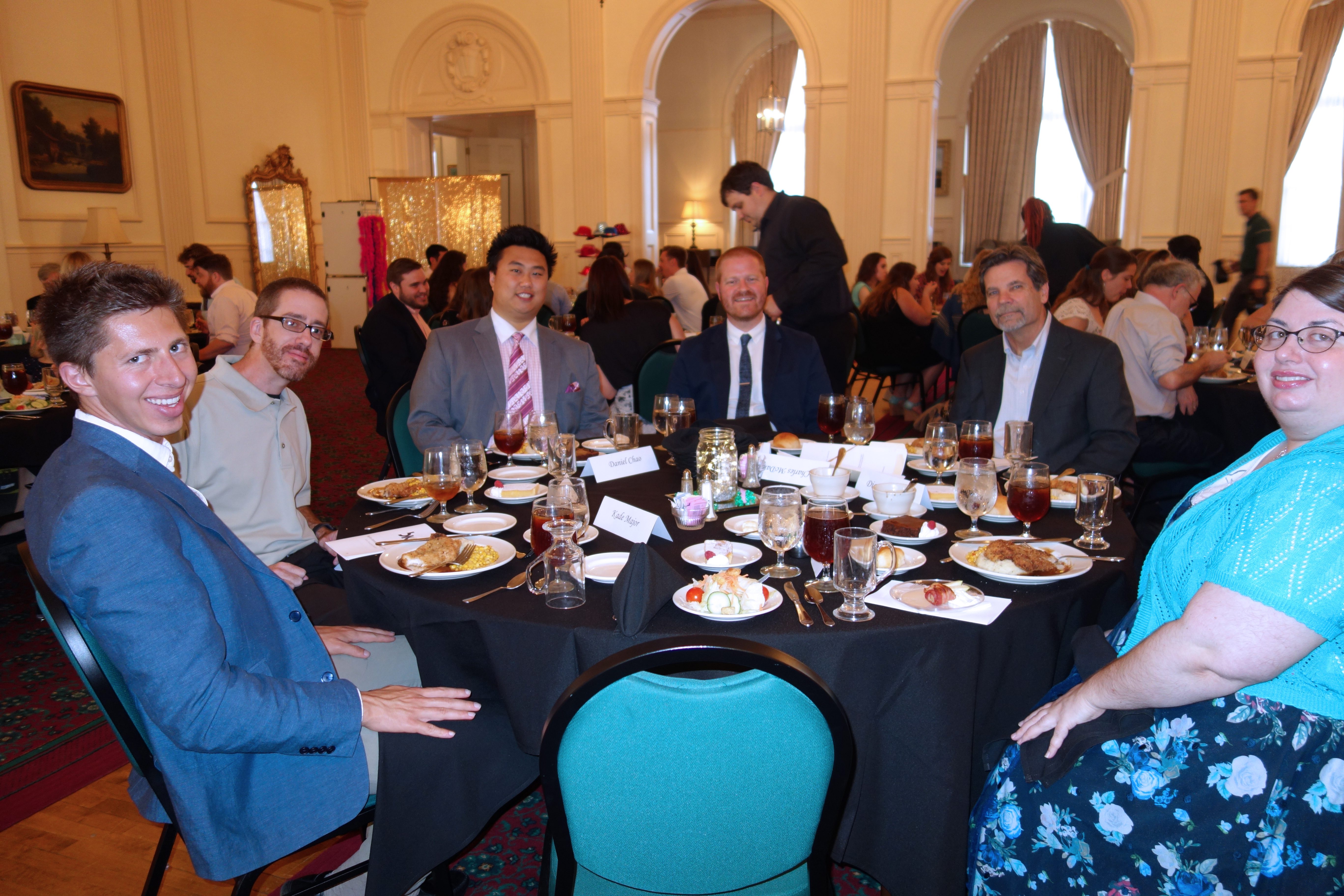
Daniel Chao is seated third from the left.

On Wednesday, April 26, 2017 we gathered to celebrate the BIC graduating students of 2017. As part of the banquet, Daniel Chao was chosen by his peers as the male BIC student to represent his graduating class and was invited to offer a few words to his fellow graduating seniors. We hope you enjoy reading his remarks from that evening’s festivities. 

———————

To say that BIC has been just a valuable learning experience would be an understatement so great I would need to complete 13 labors to atone for it.

To be honest, I can’t believe it’s already been four years. Where has the time gone? I can tell you I definitely feel 4 years older… but wiser?… well…

In all seriousness, the BIC has truly been an experience. Even if I never took one of your classes, all the professors here have made a difference, in fact, many of the quirks and habits I have picked up over these years have been from large group lectures. To the students, We have shared many memories together, and as we move onto the next steps of our lives I want to encourage everyone to put their best paws forward and give life everything you got because after all, you do only get one shot.

Dr Rust introduced me to Gregorian chant which I regularly listen to when trying to go to sleep. (not that I fell asleep during that lecture. It was all just very relaxing and enchanting) Dr. Zori’s introductory lecture on viking history and culture which thinking back might have been an interview of sorts as well. Congratulations by the way, I’m really glad you’re here. And of course Dr. Jug dressing up in some amazing costumes for his lectures. And of course, who could forget Tatums belly-dancing after the Mosque trip. All of these memories are ones that I will cherish for years to come.

There was one particular memory I wanted to share about tonight about this book. Thank you Dr. Long for allowing me to borrow it. We were studying Confucius and the lecture was about Ban Zhao who was the first female Chinese historian and also wrote the “Lessons for Women” an influential Confucian text. At the end of a lecture I decided to be a bit of a smart alec and ask a question in Chinese that went something like this. Qing Wen Ni Ke Yi Gao Su Wo Ban Zhao De Fu Xi, Xi Guan Ma? The hilarity that ensued involved references to inter-dimensional time travel and what originally began as an off the wall comment turned into a realization for me that the BIC with it’s remarkable professors who not only think quickly on their feet but also have amazing senses of humor was where I was meant to be. Its really quite an unusual memory but it all started from a large group lecture and has grown into a friendship that I hope will continue for many more years.

When I sat down to write this speech I really didn’t have any idea how to start much less end it. After asking for advice from many of my colleagues I still couldn’t give it the feel and expression I really wanted. Then I remembered my recent paper on courage that I wrote for Dr. Tatum and I realized that I needed to take a page out of that paper and be courageous enough to make this personal.

Before the BIC I was in the cave staring at the wall believing that the shadows were all that the world had to offer. Many of us students were probably in the same boat. We had aspirations and hopes and dreams that were all probably at some point shattered by the BIC.

The thing is, that the BIC took our hopes and aspirations and rebuilt them into beautiful walls of stained glass.

The books we read shaped us and gave us insight into many different philosophies. We realized that we needed to combine the critical thinking of Plato and calculations of Machiavelli with the emotion from Wordsworth to truly understand and be able to evaluate situations from different angles.

The field trips we took as a part of World Cultures allowed us to experience culture hands on and develop new perspectives from those experiences. The trips to the Japanese Gardens, Dallas Museum of Art and the many different places of worship we visited kindled a fire in our hearts and inspired us to move beyond the boundaries of the cave and learn more about the world.

I believe that each and every one of us students has something to take away from the BIC experience. The BIC has taught us to differentiate shadows from reality by thinking critically and asking good questions, and the lessons we have learned here will prepare all of us to step out into the real world. I know the cave reference is getting old but please, bear with me for one last statement.

Not all of us will be as fortunate as the professors around us to re-enter this particular cave and enlighten its inhabitants. However, eventually we will be called to enter other caves and when we are, we must take action and be prepared to do whatever is required of us. Each and every one of you has the potential to do great things and I cannot wait to see where the next chapter of our lives takes us.  BIC’EM Bears.

Posted in Current Students, Senior Recognition Banquet | Comments Off on 2017 Senior Banquet Speech — Daniel Chao

2017 Senior Banquet Speech — Kat Largent

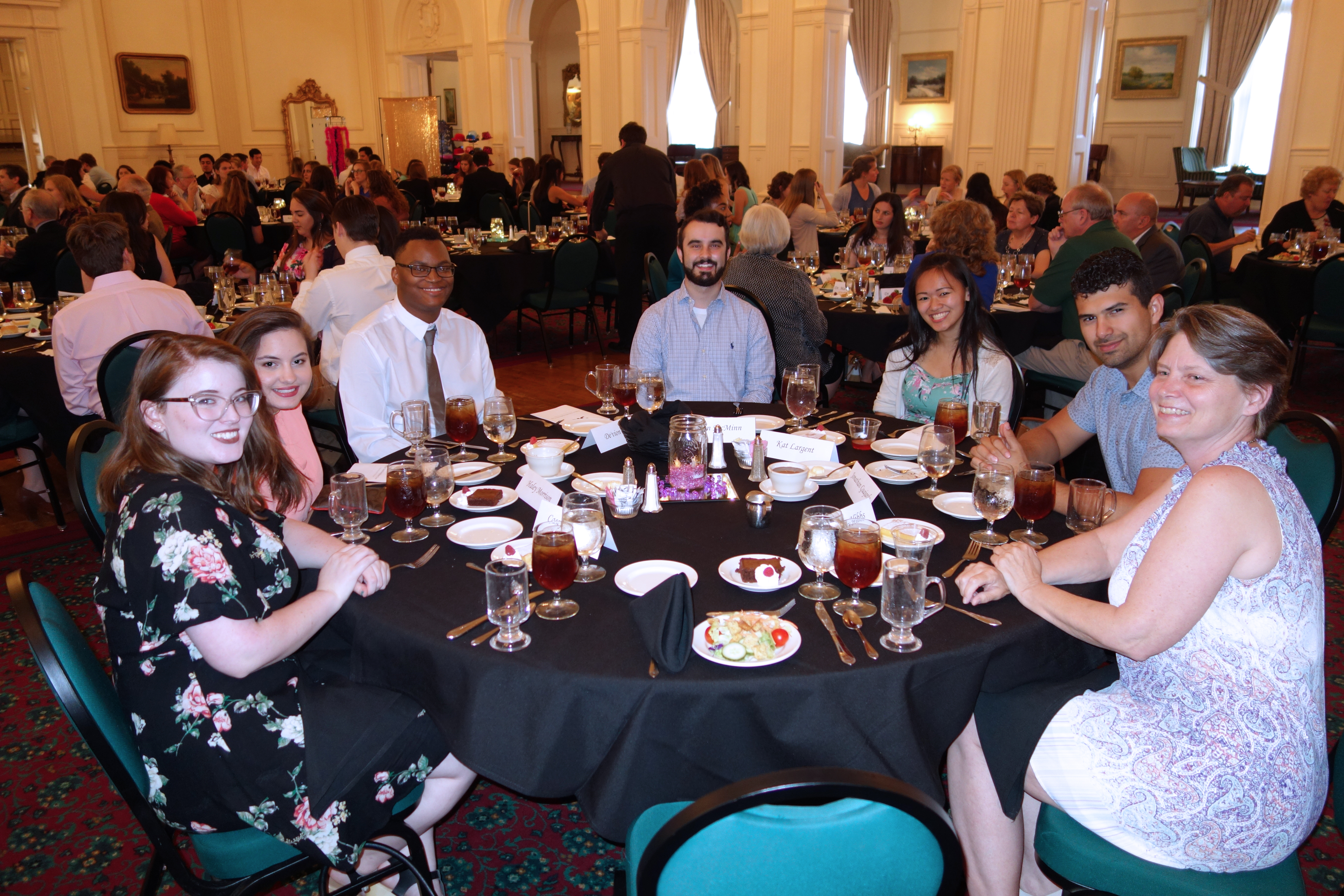
Kat Largent is seated third from the right.

On Wednesday, April 26, 2017 we gathered to celebrate the BIC graduating students of 2017. As part of the banquet, Kat Largent was chosen by her peers as the female BIC student to represent her graduating class and was invited to offer a few words to her fellow graduating seniors. We hope you enjoy reading her remarks from that evening’s festivities. 

———————

What an honor!  I remember freshman year, the upperclassmen in the Honors Residential College gave me the mock award of “Most BICly BICer”…I guess some things never change!

I’ve worked a lot of those prospective student recruitment events, Invitation to Excellence, Distinguished Scholars Days, Premiere, you know the ones. I had the pleasure of working as a student representative for BIC this last summer. The question I both loved and hated to get was the one all parents had (well, at least, besides, “what the heck is the B-I-C?”)

That question was: what is your favorite part of being in BIC?

I loved the question because it was an open invitation to get up onto the BIC soapbox and wax poetic about all the amazing features of this unique program.

I hated it because it was so hard to condense everything I wanted to say down to one idea.

The answer I usually came up with? The community.

Because, when I elaborate on it, I get to reference the bonding that happens the night before a New York Times assignment is due. I get to talk about the support network set up through fantastic peer instructors. I get to assure parents the advisors they’re talking with are so genuinely sweet and interested in seeing their students’ success, whether that means pursuing the examined life or not. I get to brag on what I term “the most incredible amalgamation of professors this university has to offer” and their genuine care for and interest in their students.

I think you all will agree when I say that BIC has done something for us each, on a very individual, personal level. Or we wouldn’t be here at ANOTHER send-off farewell event for seniors. We’ve chosen to come together one last time as a community of scholars, of dreamers, of future doctors and business people and teachers and homemakers.

Across all these divergent futures and possibilities, I see a common thread that binds us together.

We are deeply, inexorably fascinated with what it means to be human. We are seekers of truth and justice, and we believe in the possibility of a better world. And I know that there is a better world to come because all of you are in it.

Our little community has meant so very much to me the last four years and has completely transformed the way I look at the world and those who live in it. Thank you, my dearest BIC community, for shaping not only my college experience, but the many chapters yet to come.

Posted in Current Students, Senior Recognition Banquet | Comments Off on 2017 Senior Banquet Speech — Kat Largent

Note from the Director — Spring 2017

Hello BIC Alums,

I hope each of you has had a rejuvenating spring. I taught an amazing History of Classical Philosophy course this semester. I added a more explicitly political focus to the course. We read the Republic rather than the Symposium and added in sections of Aristotle’s Politics along with the Ethics. I had the additional good fortune of having almost half the class comprised of BICers. It was wonderful seeing the fruits of a BIC education, both in terms of what they had clearly learned, but even more in the ways that the BIC students exhibited an ability to engage in charitable discussion practices even in the midst of moments of discomfort and disagreement. This class was also particularly meaningful to me because of how politically engaged and aware all the students were. These young philosophically engaged Baylor students give me a great deal of hope for the future of our democratic practices.

With all the political turmoil of recent months, it is clear that more and more people are getting involved in their communities on the local, state, and national levels. I wanted to take just a moment to remind you that you can also get involved as alumni with your BIC community. There are many ways to reconnect with and give back to the BIC. You might want to return to campus and meet with current BIC students, or perhaps you would like to serve as a Mentor in our recently developed BIC Alumni Mentor Program. There is also the opportunity to connect with BIC students for one-time informational interviews about your career, or if you are currently in graduate or professional school, you might be able to connect with a BIC student to help them think through graduate school options. If writing is more your preference, you might consider writing an article for the BIC blog or agreeing to be interviewed for the BIC blog. The best way to get started is to take 5 minutes and complete our Reconnect with BIC online form. We will ask you a few questions and we can go from there. Of course, you can also stay connected with us by following us on Facebook, LinkedInTwitter, and Instagram.

I wish you all a wonderful spring and summer.

Anne-Marie Schultz
Director, Baylor Interdisciplinary Core

Posted in Alumni, Faculty, Faculty Reflection, Note from Director | Comments Off on Note from the Director — Spring 2017